

November 2025
Turning ESG noise into boardroom outcomes in 90 days
“88% of business transformations fail to achieve their original ambitions.”
Bain & Company, 2024
Boardroom question to open with
- Are you acting in the 12% that deliver or the 88% that don’t?
- We looked at our last 90 days; what sustainable strategy outcomes would drive the P&L?
Proposed Launch of new live stream
Sustainable Strategy Brief Live
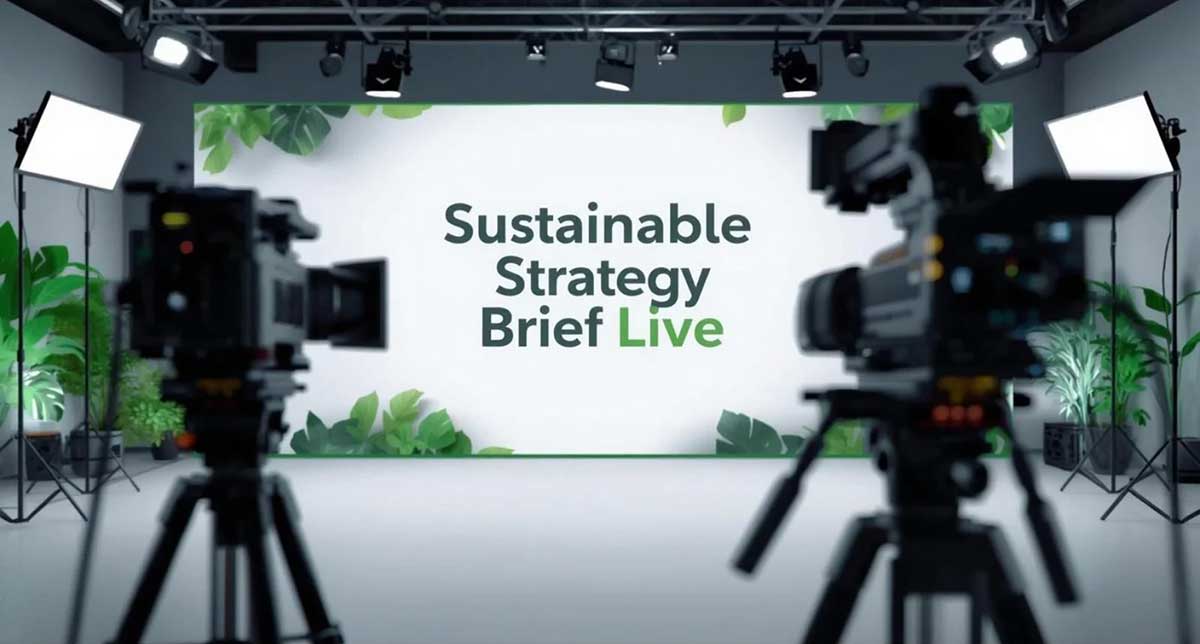
We will launch a YouTube channel @SustainableStrategyBriefLive
Sustainable Strategy Brief Live – Episode 1 will go live Wednesday 3 December 2025.
- Do join us for the first Sustainable Strategy Brief Live.
If your ESG agenda feels stuck in reporting and compliance, this first episode is for you.
I’m launching and hosting Sustainable Strategy Brief Live, a short, practical livestream on how to turn ESG 2.0 into sustainable value – not just box-ticking.
The theme of the first episode is ‘strategy eats compliance for breakfast’.
Cecilia Thorn, an ESG expert, joins me.
We will discuss:
- How ESG 2.0 creates real value for customers, employees and investors
- What new CSO and leadership skill sets are now non-negotiable?
- How shifting reporting standards are creating both turmoil and opportunity
- Three big bets for the future of sustainable strategy
📅 When: Wednesday 3 December, 1:00–1:30pm GMT
🎥 Where: LinkedIn Live, powered by Michael Baxter – The ESG Show
🔗 Watch SSBL Episode 1
8″9% of the world’s largest companies are connecting their decarbonization efforts to business value.”
Accenture Sustainability, 2025

David beats Goliath: Lessons from New Zealand’s US$3 billion Wine Revolution
One of the most powerful business lessons I have recently learnt occurred 11,500 miles from home.
I was enjoying myself on a wine-tasting tour in the Marlborough region of New Zealand’s South Island with my wife. After visiting three excellent vineyards with our capable tour guide, Stephen, I began to ponder. New Zealand produces less than 1% of the world’s wine, yet Marlborough Sauvignon Blanc dominates the UK white wine market.
From having no presence in 1973 to securing a premium position in one of the most competitive markets, the Marlborough story exemplifies a masterclass in sustainable strategy execution.
Key lessonsDespite its small size, New Zealand has leveraged its environmental advantage in wine production to achieve sustainability and ESG success.
Ongoing momentum in its strategic innovations, which tackle market and environmental demands, drives its success.
Five key takeaways include:
- Diversification under climate pressure – Agroecological practices maintain a high level of sustainability management of their vineyards. Today, its distinct climate and terroir differentiate its products in a competitive global market.
- Experimentation and Resilience – The New Zealand wine industry has enhanced the resilience of its crops by blending different varieties. Viticulture has been enhanced through experimentation with cultivation and harvesting strategies.
- Value chain discipline – The New Zealand wine industry is not immune to the cost-of-living crisis, with declining local demand and rising production costs, alongside global competition. However, its wine value chain, including vineyard production, wine production, logistics, and distribution, protects its market position.
- Market innovation – New Zealand Sauvignon Blanc is one of the most successfully marketed wines of the past century. Its market-leading position and reputation for high quality in its premium market segment serve to safeguard its offerings.
- Global ambition – Despite its small population of 5 million, being one of the world’s top 10 largest wine producers provides a disproportionate influence. However, the global impact of declining sales, cost increases, and competition from cheaper and lower-cost wines makes it essential for Marlborough’s Sauvignon Blanc to maintain consumer satisfaction.
Boardroom questions for you
- What is your equivalent of Marlborough’s terroir, a structural advantage you under-leverage today?
- If you mapped your end-to-end value chain, where could you build resilience and sustainability that protects margin?
The Sustainability Mirage: Why “Less Bad” is Still Bad for Business
Are We Deceiving Ourselves About Corporate Sustainability?
In many quarterly earnings calls, we hear about reduced carbon intensity, but absolute emissions continue to rise.
A thought struck me: instead of businesses becoming sustainable, they may be becoming less unsustainable.
This distinction isn’t semantics. It’s the difference between slowly walking toward a precipice versus turning around entirely.
The two-path reality
Arguably, today’s businesses face a stark choice:
Path 1: Incrementalism
Continue business-as-usual with incremental improvements. Emissions per unit fall, but total impact keeps rising. Many stakeholders believe companies use sustainability claims to improve their image
Path 2: Redesign
Fundamentally redesign operations so negative impacts fall below planetary boundaries and stay there. This requires changes to business models, capital allocations, and incentives.
Former Unilever CEO Paul Polman warns that we have at most two generations to implement Path 2 globally. Not to figure it out, but to have it fully operational.
The leadership crisis
Yet what do we see?
- recent collapse of global plastics negotiations.
- prioritise quarterly profits over generational survival. Sustainability reports that read like PR writing exercises.
The real question haunting boardrooms should be: What will you tell your grandchildren when they ask why you chose short-term gains over their liveable future?
The opportunity hidden in crisis
Here’s what most appear to miss: true sustainability isn’t just an ethical imperative; it’s the ultimate journey to competitive advantage. Organisations that crack this code first will create a competitive moat that dominates their market space.
Boardroom questions for you
- Our current trajectory: are we on Path 1 or Path 2? What evidence would convince a sceptical investor?
- Can part of our business be a Path 2 pilot in the next 12 months?
- Do our capital allocation decisions align with planetary boundaries and long-term resilience?
Three steps to take
Your organisation’s most significant threats and constraints could become its strongest differentiators. While your competitors develop more sustainable strategies, will you also be a leader known for implementation?
- Schedule Your 20-Minute Sustainable Strategy Starter Conversation—we’ll discuss your organisation’s untapped sustainability advantages and implementation challenges. Email pap@drpaulphillips.com today. Limited diagnostic slots are available.
- Join Sustainable Strategy Brief Live – Reserve your seat for the first livestream episode of Sustainable Strategy Brief Live – strategy eats compliance for breakfast. This is a focused 30-minute live session in which we will cover: how ESG 2.0 creates real value for customers, employees, and investors; and identifying three ESG bets that matter in the next 90-180 days for your context.
- Strategic Content Co-Creation – As a Sustainable Strategy Brief executive reader, your insights on emerging strategic challenges enable us to deliver the most relevant, actionable content. Share your priority strategic themes for future issues of Sustainable Strategy Brief Live
Final call
ESG noise is harmful. It is what happens when activity multiplies, but decision quality does not.
And 90 days is not about speed for its own sake. It is about creating enough focus, evidence, and leadership discipline to turn sustainability from discussion into boardroom action.
In short:
- Focus filters the noise.
- Proof drives the outcome.
- Together, they make a sustainable strategy actionable in 90 days.
To access the latest SSBL conversations and curated clips, follow Sustainable Strategy Brief Live and subscribe to the newsletter for future editions.
Remember
If you are trying to transform your firm within your industry, look outside for ideas! Look to vineyards in New Zealand, to sectors that have already converted risk into advantage, and to greenhushers who are quietly executing rather than loudly promising.
Warm regards, Paul

Dr. Paul A. Phillips
Dr Paul A. Phillips Professor of Strategic Management and practitioner with CEO/board-level delivery experience
Founder and CEO of Investment-Grade Strategy Partners.
Author of Sustainable Strategic Management: Leadership with Purpose (with Routledge).
Founder and Host of Sustainable Strategy Brief Live.