

April 2026
From Ambition to Governed Choice
This month’s Sustainable Strategy Brief focuses on the gap between ambition and governed choice.
If leadership cannot say what should stop, it has not set a strategy. It has simply protected a portfolio of worthy activity.
Too often, the ambition is clear, but the case is not ready for scrutiny.
- No capital logic.
- No credible baseline.
- No finance involvement.
So the proposal stalls.
That is the focus of the April Sustainable Strategy Brief.
“In many organisations, the problem is no longer whether people care about sustainability.
The harder challenge begins later, when sustainability has to compete for attention, resources, capital, and confidence within the organisation’s real decision-making machinery.
That is where good intentions are tested.”
Paul Phillips FRSA
Thought for the month
Over the past month, I have been reminded that sustainability is rarely held back by a lack of good intention.
More often, it is held back by how difficult it is to turn that intention into choices that are clear, credible, and durable inside real organisations.
That has come through repeatedly in my recent writing, conversations, and Sustainable Strategy Brief Live episodes.
People care. Many organisations want to make progress. But the harder questions begin once sustainability has to compete for attention, resources, and confidence.
The real work now is not to raise the volume of the conversation, but to improve its quality. Not to add more language, but to help leaders make better choices.
“Sustainability is not dead – CEOs, consumers and B2B buyers continue to act sustainably, and tie it to business value.”
Bain & Company, 2025

Why boards need a decision architecture for sustainability
One of the biggest failures in sustainability strategy is not weak intent. It is weak decision design.
Too many boards are still being asked to approve sustainability proposals that sound serious and align with corporate ambition, but lack the architecture required for disciplined strategic choice.
That is why seemingly strong cases still break down under scrutiny.
A board cannot govern aspiration alone. It needs a proposal that makes the baseline explicit, assigns ownership clearly, defines the proof threshold, and shows what would cause leadership to stop, redesign, or scale differently.
This is the central argument in my new Sustainable Strategy Executive Paper, Why Boards Need a Decision Architecture for Sustainability.
Because boards do not fund aspiration. They fund governed choices.

SSBC-D Lite Diagnostic Tool
Most sustainability business cases do not fail at the end. They reveal their weakness much earlier, often in the language they use to defend themselves.
A weak case often sounds like this:
- This matters.
- This fits our strategy.
- This is urgent.
A stronger case sounds different:
- Here is the value at stake.
- Here is the defendable baseline.
- Finance shaped the case early.
That is the real divide. Not sustainability versus profit. Not ambition versus scepticism. It is the difference between weak signals and stronger signals.
That is why SSBC-D Lite, my new diagnostic tool, helps you assess whether your sustainability strategy is ready for board-level and investment-grade scrutiny. It starts with three checks: capital logic, baseline credibility, and finance involvement.
If those are weak, the case is usually weaker than it looks.
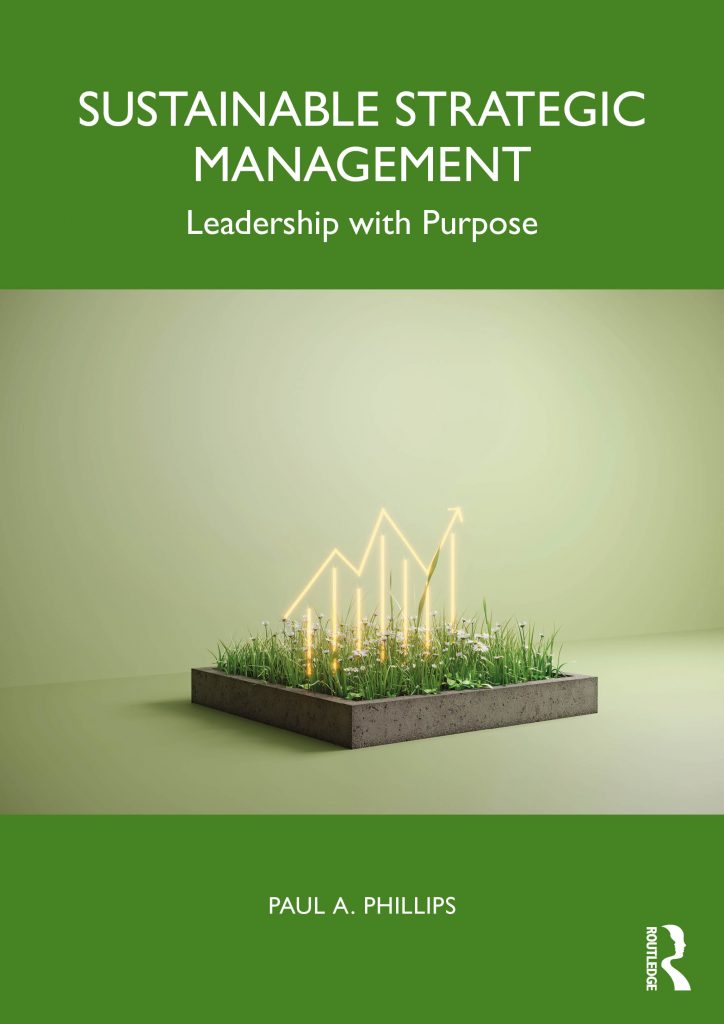
New Publication
I am delighted to share the publication of my latest textbook, Sustainable Strategic Management: Leadership with Purpose with Routledge.
The textbook reflects a core belief in my work: sustainability should not sit at the margins of strategic management. It belongs at the heart of strategy, leadership, and long-term value creation.
Written for business school teaching and scholarship, it is also intentionally practical, offering frameworks and tools to help leaders, executives, and educators move from sustainability and ESG compliance to value creation.
I hope it encourages stronger practice, better leadership thinking, and deeper conversations about the future of sustainable strategic management.
Further Reading and Resources
Read: Why Boards Need a Decision Architecture for Sustainability
Try: SSBC-D Lite
Explore: Sustainable Strategic Management: Leadership with Purpose
Watch: Sustainable Strategy Brief Live
Subscribe: to Sustainable Strategy Brief for future board-level insights.
For speaking, executive education, advisory work, or collaboration enquiries, please get in touch.
Warm regards, Paul

Dr. Paul A. Phillips
Dr Paul A. Phillips Professor of Strategic Management and practitioner with CEO/board-level delivery experience
Founder and CEO of Investment-Grade Strategy Partners.
Author of Sustainable Strategic Management: Leadership with Purpose (with Routledge).
Founder and Host of Sustainable Strategy Brief Live.