
June 2026
Nature Is Not Short of Importance. It Is Short of Investment-Grade Propositions.
Last month’s Sustainable Strategy Brief argued that sustainability proposals must survive CFO scrutiny. This month, the agenda takes that argument into a harder and more commercially urgent space: nature, natural capital, AI-enabled sustainability, capability building, and market execution.
The core message is simple. Sustainability is entering its capital phase. The organisations that win will not be those with the most ambitious language. They will be those who can convert sustainability, nature, and resilience claims into credible, investable, and governed propositions.
This matters because the market signal is becoming sharper. UNEP’s 2026 State of Finance for Nature report shows that for every US$1 invested in protecting nature, around US$30 is spent on activities that damage it.
At the same time, the opportunity side is expanding. The World Economic Forum and Oliver Wyman estimates that opportunities could contribute up to US$10.1 trillion in annual business revenues and cost savings by 2030.
“The gap is not only financial. It is strategic. Too many sustainability and nature proposals still rely on importance, urgency and moral legitimacy.”
Paul Phillips FRSA
Energy transition is now a board test
Energy transition is no longer just a sustainability issue. It is now a board test.
The World Economic Forum’s Energy Transition Index 2026, produced with Accenture, reinforces a harder reality. Transition ambition is rising, but readiness, execution capacity and investability remain uneven.
That should concern every board and CFO.
Capital deployment is not the same as investability. Renewable projects, grid upgrades and transition plans will not scale simply because they are strategically important. They need credible economics, policy stability, infrastructure capacity, governance, risk controls and execution discipline.
The question is no longer whether organisations support the transition.
The sharper question is whether their transition proposals can withstand capital scrutiny.
Can finance validate the economics?
Can the board see the risk and value logic?
Can governance define when to fund, pause, redesign or stop?
This is where investment-grade sustainable strategy matters. It is not communication. It is the discipline that turns ambition into decisions that boards can fund, monitor and defend.
The real test is whether boards can distinguish between what is strategically important and what is genuinely investment-grade.
Boards that fail to make that distinction risk funding their ambitions without the economics, governance, and execution discipline required to deliver them.

Sustainable Strategy Brief Live – Episode 4
After the show, what should leaders do next?
One takeaway from the show was that over the next 90 days, leaders should take one live sustainability strategy and stress test it. Are the assumptions credible? Does the business case hold? Is the organisation ready for what is coming next? Do customers and suppliers see the strategy as commercially relevant? And, perhaps most importantly, who is accountable if the financial case does not hold?
This is the scenario in which many organisations need a sustainability cockpit. They may have dashboards, metrics and indicators, but they must connect them to capital allocation, risk, ownership and board decisions.
Once the presentation ends and the advisers leave the room, the organisation still needs a mechanism to track whether commitments are turning into action.
For me, the message is simple. In the next 90 days, avoid adding more sustainability language. Stress test one live case. Build the cockpit. Make sure the strategy remains credible when pressure arrives.
Guest Mark J Lumsdon-Taylor, Global Executive Lead, Development & Sustainability and Partner at MHA, Moderator Rob Smith, former Main Presenter, BBC South East; and I put the topic under scrutiny in SSBL Episode 4.
Next steps: If these themes resonated, do watch a clip in which the three of us discuss the topic.
“Nature represents both a source of systemic risk and a foundation for long-term prosperity.”
World Economic Forum, 2026
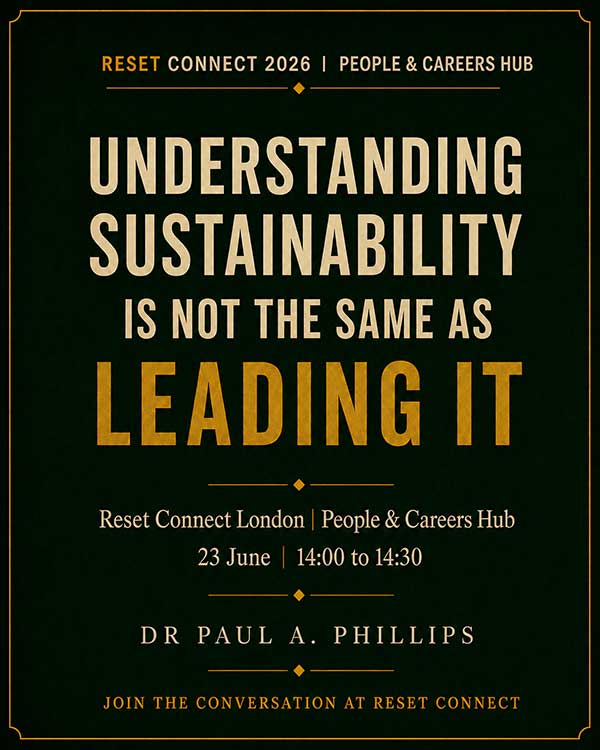
Reset Connect London, 23rd June 2026
At Reset Connect London, during my presentation, my message was simple: understanding sustainability is not the same as leading it.
Many organisations now speak the language. They have commitments, reports, targets and dashboards. But the harder test begins when sustainability has to compete for capital, survive CFO scrutiny and change how the organisation works.
That is where the real capability gap appears.
Sustainability leadership is no longer about awareness alone. It is about turning sustainability into capital choices, risk decisions, operating model changes, accountable delivery and measurable value.
Boards need leaders who can ask sharper questions: What are we funding? What risk are we reducing? Who owns delivery? What evidence will prove progress? What happens if the assumptions fail?
This is the book-to-board challenge behind Sustainable Strategic Management: Leadership with Purpose.
The next stage of sustainable strategy will not focus on better reporting. It will be defined by whether leaders can move from reporting to real impact and from sustainability language to decisions that boards can fund, monitor and defend.
Five takeaways from my Reset Connect session were:
- Sustainability capability is not keeping pace with sustainability investment. More spend without better decision competence risks better-funded underperformance.
- The green transition is a strategic learning challenge, not just a reporting or compliance exercise.
- Many organisations still focus on targets, reports and partnerships. Value emerges when sustainability becomes part of strategy, capital discipline, and institutional impact.
- Boards need to ask sharper questions: Where is the value? Can finance test the case? Who owns the decision? And how will outcomes be proven?
- The next move is practical. Bring one live sustainability case, stress-test the assumptions and see whether it can survive board and CFO scrutiny.
If any of these questions expose a gap in your organisation, that is where a sustainable strategic management diagnostic conversation can begin.
Three ways to take the next step
- Stress-test one of your live sustainability challenges
Choose one current sustainability issue affecting strategy, capital, risk or execution. Test whether the case is decision-ready, where the gaps sit and what must change next. - Turn one initiative into a board-ready case
Apply the Five Test Standard in the Sustainable Strategy Executive Brief, May 2026 – Investment Grade or Just Language? to
convert one sustainability initiative into a case that can withstand scrutiny: clear decision, credible evidence, financial consequence, named ownership and 30/60/90 day action gates. - Start an executive capability conversation
Arrange a focused discussion on how your organisation can move from sustainability reporting, awareness and training activity into investment-grade strategy execution. The aim is not more language. It is better decisions, stronger governance and measurable value.
Warm regards, Paul

Dr. Paul A. Phillips
Dr Paul A. Phillips Professor of Strategic Management and practitioner with CEO/board-level delivery experience
Founder and CEO of Investment-Grade Strategy Partners.
Author of Sustainable Strategic Management: Leadership with Purpose (with Routledge).
Founder and Host of Sustainable Strategy Brief Live.