

September 2026
Before You Approve the Benefit, Test What Else the Decision Changes
A sustainability proposal can promise lower emissions, reduced costs or stronger resilience and still leave the organisation with a weak decision.
The problem is often the gap between the proposed action and the claimed result. A company invests in new technology, but the operating process does not change. A supplier is replaced, but risk moves elsewhere in the value chain. A cost reduction improves this year’s figures while removing a capability needed for future growth.
Sustainable strategy requires leaders to examine the whole consequence of a choice, not simply its most attractive benefit.
This month, I want to offer a practical challenge: take one material proposal approaching approval and ask whether its promised value can survive contact with the organisation that must deliver it.
“Did applying the discipline materially improve the decision, and can that improvement be demonstrated?”
Paul Phillips FRSA
Sustainability becomes strategy at the point of choice
Targets and commitments establish direction. Strategy begins when leaders must choose between competing uses of money, people and time.
Should an organisation invest now in a lower-carbon operating model or extend the life of existing assets? Should it pay more for a resilient supply chain when the financial return is uncertain? Which activity should stop so that resources can move to a more valuable one?
These choices cannot be settled by ambition alone. Leaders need to know the expected financial and wider value, the assumptions behind it, who can deliver it and what they will do if the result fails to appear.
A proposal becomes stronger when its sponsors can trace its main claim:
Action → operational change → financial or institutional consequence → observable evidence
For example, an investment in energy efficiency may have a credible technical case. The strategic case also depends on installation costs, operational disruption, energy use, the life of the asset and who will respond if performance falls short. The investment may still be the right choice. These questions establish what leaders are actually committing to.
A lesson from higher education
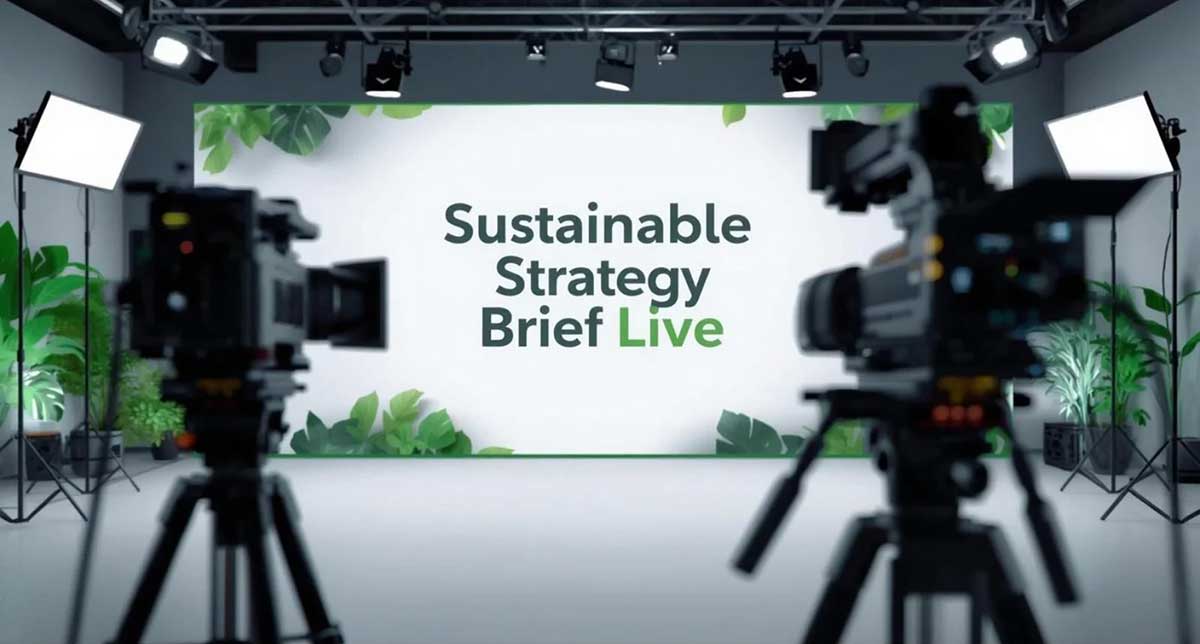
Sustainable Strategy Brief Live has also been evolving. Its value increasingly lies in sharpening the questions leaders should ask before consequential decisions are made.
September’s episode brought this into focus through the financial pressures facing universities. In discussion with guest Sam Sanders (Head of Education, KPMG UK) and moderator Rob Smith, we examined how financial, academic and public-purpose perspectives can lead to different judgments about the same proposal.
A programme closure may deliver necessary savings while weakening recruitment, research relationships or specialist capability. Equally, an activity with considerable academic value may depend on a financial model the institution can no longer sustain.
Strategy begins when leaders choose between competing forms of value and accept the consequences.
The setting was higher education, but the leadership problem is universal. Cost reduction can erode capability. Growth can increase risk. Digital investment can improve productivity while creating new dependencies. Sustainability commitments can strengthen long-term value while increasing near-term capital requirements.
The strategic task is to make those trade-offs visible before commitment.
Which source of value might your preferred proposal weaken, and has that consequence been properly examined?
Next steps: Watch the accompanying clip in which Rob Smith asks Sam Sanders about strategic ambition and meaningful strategic choice.
Sam offers a simple test: If the opposite of a strategic commitment is ridiculous, is it really a strategic choice?
“It’s crucial to continuously reallocate resources, make deliberate trade-offs across a portfolio of opportunities, and commit early despite uncertainty.”
McKinsey, 2026

Three statements to put in the proposal
Choose one consequential proposal due for approval in the next 30 days. Ask its sponsor to complete these statements:
- The value at stake is …
State the expected benefit and the financial, operational or institutional value the action could put at risk. - The benefit depends most on this assumption…
Identify the assumption whose failure would most weaken the case. Say, what evidence would reveal that failure? - The strongest challenge we have not resolved is…
Present the best objection fairly. Name who will resolve it and when.
If the answers are weak, uncertainty should change the approval request. Leaders may proceed with conditions, change the proposal, stage the commitment or stop. Recording a risk while approving the original proposal without change is not the same as addressing it.
What I am testing in my own work
August’s brief set a demanding standard for the decision methods I have been developing. By applying them to a consequential live choice and establishing whether the decision improves.
That remains the next step. The purpose of a decision test is to make assumptions, economics, competing forms of value and ownership visible while leaders can still act on what they find. Its value must be demonstrated through real application and measured results.
For your next approval meeting, ask one question: If the most important assumption proves wrong, who will know, when will they know, and what will they be authorised to change?
If the answer is unclear, the proposal needs more than a stronger narrative. It needs a better decision.
If you have a material proposal approaching approval, reply with the decision requested and its approval date. No confidential papers are needed for an initial conversation. I can identify the first assumption I would challenge, and we can establish whether a fuller, independent decision test would be useful.
Warm regards, Paul

Dr. Paul A. Phillips
Dr Paul A. Phillips Professor of Strategic Management and practitioner with CEO/board-level delivery experience
Founder and CEO of Investment-Grade Strategy Partners.
Author of Sustainable Strategic Management: Leadership with Purpose (with Routledge).
Founder and Host of Sustainable Strategy Brief Live.