

October 2026
Before You Commit Capital, Test the Decision
A board can approve a compelling strategy, a technically feasible project or an apparently attractive investment and still make the wrong decision.
The problem is not necessarily poor analysis. It is the distance between what a proposal promises, what an organisation can actually deliver, and what might change as a consequence.
In September’s Sustainable Strategy Brief, I argued that leaders should examine what else a decision changes before approving its promised benefits.
October’s work has sharpened that argument.
Across higher education, artificial intelligence, natural capital and the development of my Investment-Grade Sustainability Operating System (IGSOS), one issue keeps returning.
When is there enough evidence, economic justification and organisational capability to make a consequential commitment?
The answer cannot be a compelling narrative alone. Nor can it be a financial forecast that assumes successful implementation.
“Technical feasibility tells us what can be done. Strategic judgement determines what deserves commitment.”
Paul Phillips FRSA
Investment-grade strategy begins before the commitment
Boards increasingly face decisions in which several legitimate objectives compete.
An investment may improve environmental performance while increasing financial exposure. A university restructuring may deliver savings while weakening the capabilities required for future growth. An AI initiative may improve productivity while creating new costs, dependencies and governance risks.
These are strategic choices that require boards to weigh competing priorities, assess trade-offs and determine which course of action offers the strongest long-term value.
The key question is not whether a proposed intervention offers benefits. It is whether those benefits justify the resources, risks and capabilities required, particularly when credible alternatives exist, and funds are scarce.
A stronger investment case connects:
Strategic choice → causal mechanism → financial and wider consequences → evidence → accountable delivery
Each connection matters.
Expected benefits may fail to materialise because the assumed operating changes do not occur. Forecast savings may remain unrealised, while proposed investments may depend on capabilities that have yet to be developed.
A strategic decision becomes investment-grade when its underlying assumptions, alternatives, consequences and conditions for success can withstand scrutiny.
The same challenge is emerging in artificial intelligence
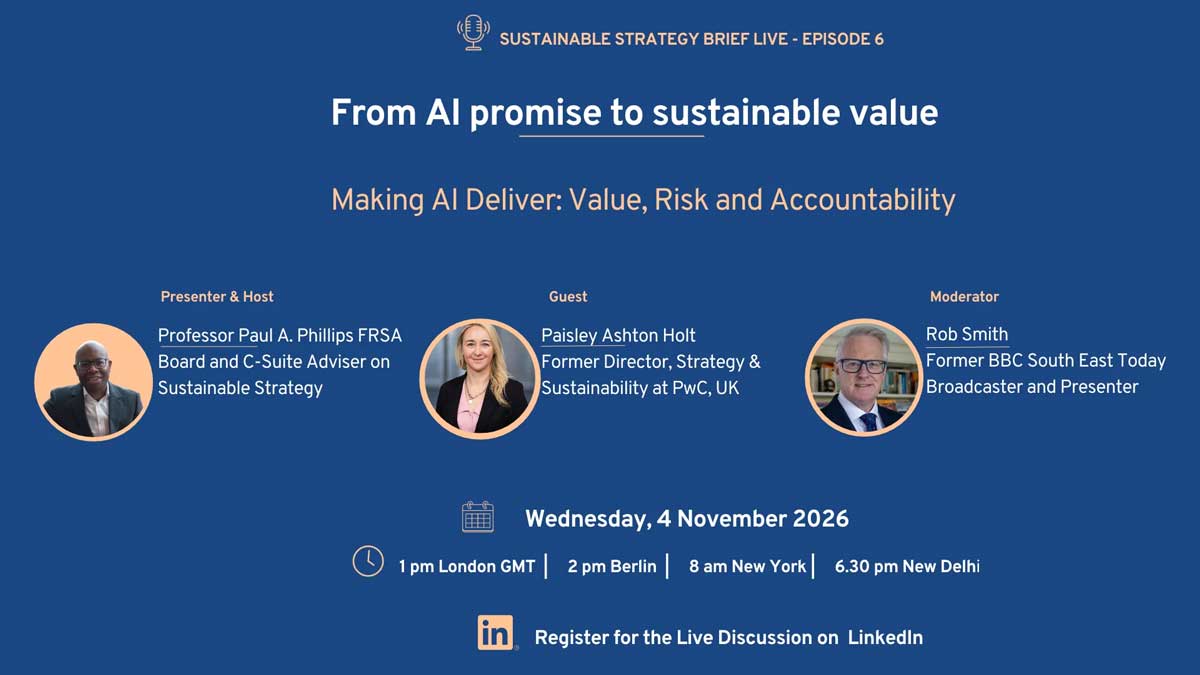
My forthcoming Sustainable Strategy Brief Live discussion, From AI Promise to Sustainable Value, extends this decision challenge into AI investment.
I will be joined by Paisley Ashton Holt, former Director, Strategy & Sustainability at PwC UK, with Rob Smith moderating. The discussion takes place online on 4th November at 1pm GMT. You can register here:
The discussion will examine three connected questions.
Value: Where is AI delivering measurable sustainability and business outcomes rather than simply improving reporting?
Risk: How should leaders balance financial, environmental and organisational risks when investing in AI?
Accountability: What should leaders and managers require before approving, scaling or stopping initiatives?
AI creates a particularly demanding strategic challenge because organisations can introduce technology faster than they change the processes, skills and management systems required to capture its value.
An AI business case may promise substantial productivity improvements. But those gains depend on adoption, redesigned workflows, reliable data, governance and the ability to release or redeploy resources.
The strategic task is therefore to decide which applications deserve commitment, what capabilities must accompany them, and what evidence will justify further investment.
The same discipline applies whether the proposed investment is in AI, environmental infrastructure or institutional transformation.

Three questions for your next investment decision
Choose one consequential proposal due for approval in the next 30 days. Ask its sponsor to complete these statements:
- The value depends on…
Identify the assumption most critical to delivering the expected benefit. Explain what evidence supports it and what would indicate that it is failing.
- The strongest alternative is…
Identify an alternative strategic option. Assess its potential benefits, sacrifices and trade-offs, and explain whether it offers greater overall value than the original proposal.
- We will reconsider the commitment when…
Specify the evidence that would trigger a review, who has authority to act, and what could be changed, staged or stopped.
Where the answers reveal material uncertainties, the response should go beyond adding another paragraph to the business case.
The proposal may need different approval conditions, further evidence, a staged commitment or redesign.
Recording uncertainty without changing the decision does not mean that uncertainty has been addresse
What I am testing in my own work
This month I have continued developing IGSOS as a practical approach to independent, pre-commitment decision assurance.
The emphasis is on consequential choices where financial exposure, strategic value and organisational capability must be considered together.
Two applications are taking shape.
The University Decision Test examines major institutional proposals, including portfolio restructuring, international expansion, mergers and collaborations, before proposals reach governing bodies for approval.
The Sustainability Decision Test applies the same discipline to sustainability investment, decarbonisation, circular economy, natural capital and sustainable technology choices.
Both seek to make the decision clearer through a focused assessment of evidence, economics, competing forms of value, ownership and implementation conditions.
The intended outcome is a better-supported decision, with clear reasons and conditions: Proceed, Change, Stage or Stop, with reasons and conditions.
There is also an important test for my own work.
A method should not claim success because its logic is persuasive or its framework is comprehensive. It must demonstrate that its application improves an actual decision.
That is why the next priority is to apply this discipline to a small number of live, consequential proposals and establish what difference it makes, including where it falls short.
For your next approval meeting, I would suggest one final question:
What would we need to learn that would make us change this decision before the full cost of being wrong becomes unavoidable?
If the board cannot answer, the organisation may be ready to approve a proposal without yet being ready to manage its consequences.
If you have a material investment or strategic proposal approaching approval, reply with the decision being considered and its expected approval date. No confidential papers are needed for an initial conversation. We can establish which assumption deserves the closest scrutiny and whether an independent decision test would be useful. If you do not have a live decision, I would still welcome a one-line reply: which of the three questions would your organisation find hardest to answer today?
Warm regards, Paul
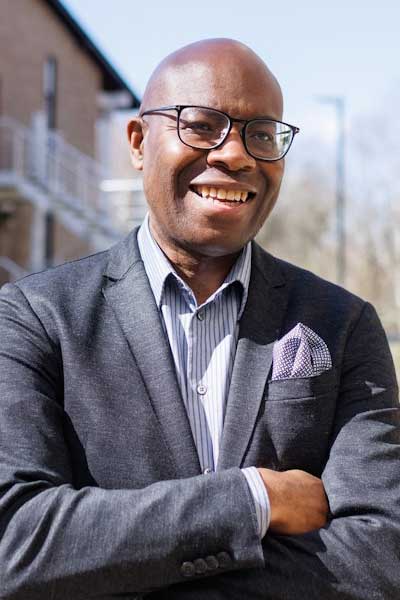
Dr. Paul A. Phillips
Dr Paul A. Phillips Professor of Strategic Management and practitioner with CEO/board-level delivery experience
Founder and CEO of Investment-Grade Strategy Partners.
Author of Sustainable Strategic Management: Leadership with Purpose (with Routledge).
Founder and Host of Sustainable Strategy Brief Live.